博文

目前显示的是标签为“chinesetea”的博文

Tasting autumn tea at LaoBanZhang village and have a comparison of GuShu and Shrub.

图片
The gate to LaoBanZhang village.  A classical house of local farmer's in village.  We had a comparison of GuShu and Shrub' maocha.  Gushu means more than 300 years old, but shrub is under 70 years old.  When we talk about gushu, we must confirm the age of the tea tree. Then we will decide to call that gushu, dashu, organic tree or shrub by ourself.  Both gushu and shrub are picked just in this autumn and almost processed at the same time.  My local partner put both leaves into one basket and asked me to separate gushu from shrub.  What do you think about that? Which is gushu, which is shrub?  The newly processed tea leaves have a fragrance of like grass. They told us these were just picked up days ago. How to describe these leaves? Long. These are really very long. I select one with straight stem and put that on my hand like below. 一芽两叶(yi ya liang ye)which means one bud with two leaves. With t...

YiWu spring high mountain tea

图片
This tea was also bought directly from local farmer of YiWu. Their village is called GaoShanCun. GaoShan means high mountain. These tree are around 100 years. These are still not called GuShu or old tree. In my humble opinion, GuShu should be more than 300 years at least. From 100 years to 300 years, we call that DaShu which means Big Tree. From 70 years to 100 years, we call that ShengTai which means Organic Tree. Till 70 year, we call that XiaoShu which means small tree or shrub. This tea was definitely picked up in the spring of 2017. Now is November and near the end of 2017. Thanks to the good storage condition, it is very dry. The flavor is very near wood or dry wood and mixed with aroma like honey or flower. In Chinese, I can directly call this flavor HuaMi Xiang which means flower and honey flavor. Maybe the wood flavor is not because of storage condition or any other reason. Just because it was stored dryly. So the stem has this smell. At the same time, I ...

14 Big puerh tea mountains in XiShuangBanNa YunNan China ( 2/2 )

图片
Last time, we talked about 6 big puerh tea mountains in east of LanCang river which is called Mekong river internationally on google map.  The problem is that along with the rising consumption of puerh tea in market and mainly in domestic market, the harvest of these 6 mountains is becoming less and less because of over-picking. Now the most harvest tea area has moved from east of LanCang river to the west side including 8 big tea mountains which will be introduced this time from north to south. 1. ManNuo (曼糯)   (pic source:  中国普洱茶网  ) ManNuo is in the most north side of MengHai county and belongs to MengWang village, MengWang town also near the border of LanCang district and SiMao district.  The elevation is around 1200m to 1300m. Annual precipitation is around 1300mm to 1400mm.  Old trees are mainly in 3 villages including Big village, Up village and Middle village.  In history, here was one of the important route from MengHai to ...

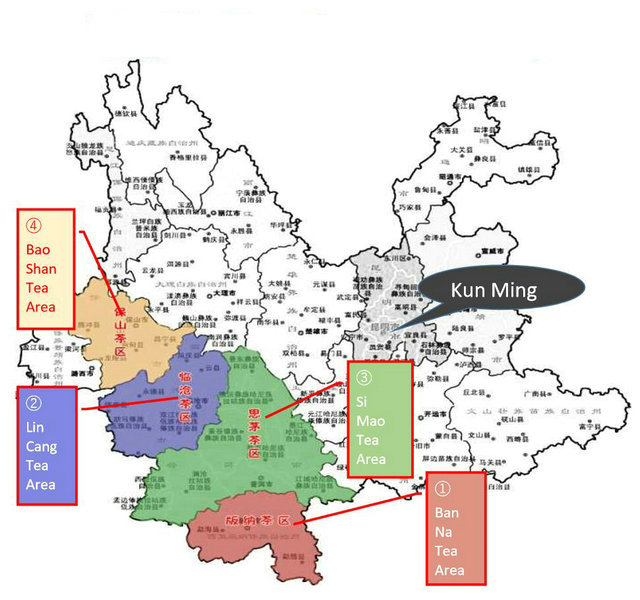
The Big 3 Puerh Tea Areas in YunNan province.

图片
Maybe some people don't agree with me. "Are there should be 5 tea areas instead of  just 3?  Such as YiWu, MengHai, SiMao,LinCang and BaoShan?" "No,no, there should be 6 big tea areas. DaLi should be included" Okay. Let me just talk about the big 3 tea areas along the LanCang river baisn. It is located in the south of North Tropic. This unique region belongs to tropical and subtropical climate. It is so special and very suitable for growth of tea trees. The tea quality is among the best in whole Yunnan province. The big 3 tea areas. Source: 慢时光_Tina ① BaNa tea area.     According to the recorded history, farmers started to plant tea trees from Eastern Han Dynasty (AD 25 year-220 year). Tea as a agricultural industry began to rise up from Tang and Song Dynasty(AD 618 year-907 year, 960-1279 year),  and reached the peak during Ming and Qing Dynasty (AD 1368 year-1644 year-1912 year).  Cha Ma Gu Dao which means tea and horse tra...

Large leaf. Your puerh tea's is from arbor or shrub?

图片
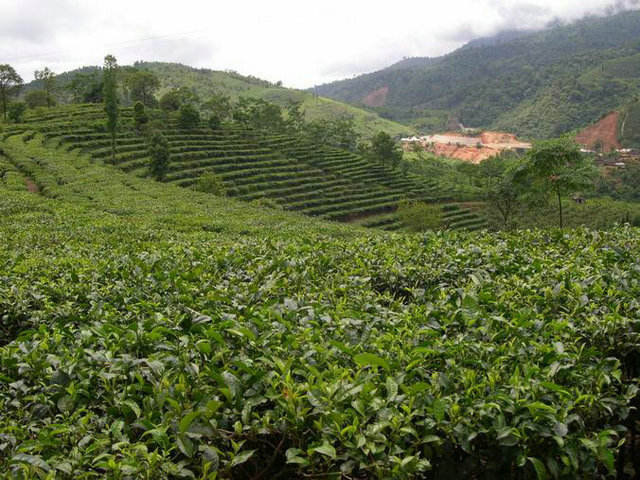
Shrub plantation of puerh tea Shape of shrub The front side of shrub's leaf. Compared to arbor leaf it is narrower on width and shorter on length and thinner on thickness. Selected shrub's leaf to make puerh tea. The back side of the leaf. The advantage is that the bud is fat and easier to be picked up. Also can be harvested more from same size of plantation, so the economy side is better. But not suitable to be made into traditional puerh tea. Because of the monotonous taste and poor tea water. The fragrant is thinner and the levels of the taste is not so obvious. Usually, arbor tree needs good environment especially non-polluted soil, clean water and atmosphere.  Then the arbor can grow to large tree and high quality large leaf. These trees have tall and sturdy trunk. Classical arbor tree.  Branches of arbor tree. "Hi. Shrub little brother. Let's have a comparison. "😁 Arbor tree said.  "Oh. My God. ...